
A conversation between director Sifan Shao and set designer Ma Xin
In this production of Jean Genet’s Les Bonnes, directed by Sifan Shao and produced by XiaoNianQing Theatre Company, the stage space transforms throughout the performance.
The set is not merely an environment in which the actors perform. It becomes part of their performance, changes through their actions, and continually reshapes the audience’s perception of the stage.
Sifan Shao and Ma Xin reflect on their collaboration: the creation of a symmetrical space, the role of flowers, the relationship between reality and artifice, and their search for a form of immersion rooted above all in the audience’s sensory experience.
Sifan Shao: Over the past few days, I’ve been thinking back on our work, and I suddenly realised just how much the stage has changed from the beginning until now, haven’t you?
In a play like this, every element on stage should provide something for the actors to work with. The set cannot simply be a picture placed on stage, disconnected from the actors.
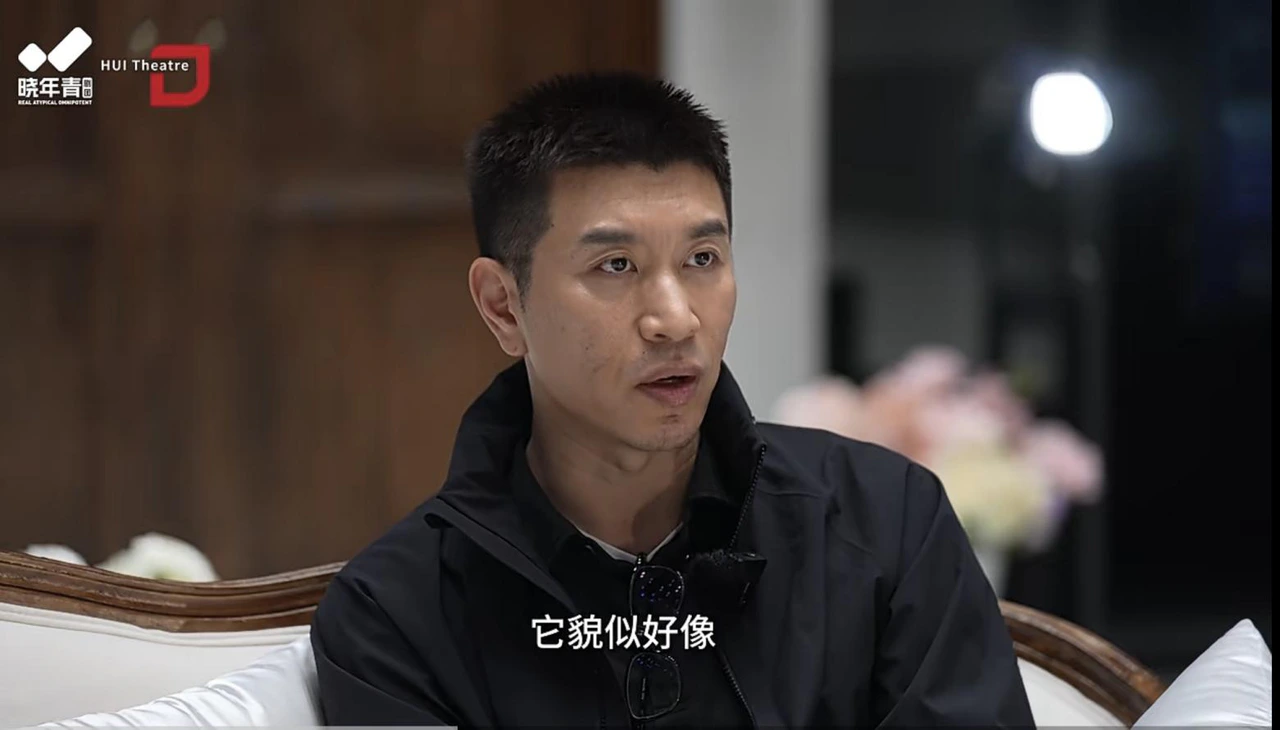
Ma Xin: When I first received the project, the first thing I did was try to translate it into a spatial form.
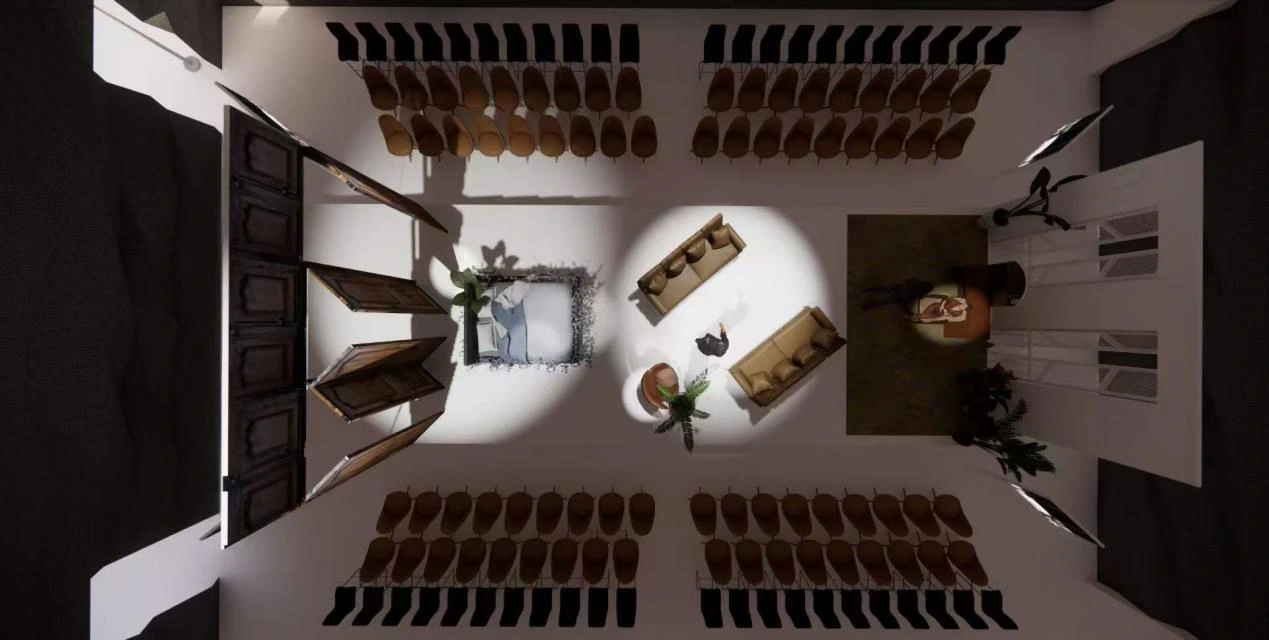
I imagined the actors as two points of light, almost like particles, moving within a structure divided into compartments. There’s a living room, a kitchen, and so on.
What I wanted to express was a very rigorous, almost absolute symmetry.
From the beginning, we decided to place the audience on both sides of the stage. That way, when they think back on the performance, on Madame’s actions within that space, the memories held by the two sides are actually opposed.
But at a particular moment, the stage begins to rotate, and that rotation completely distorts the memories of both sides of the audience. I found that idea incredibly exciting.
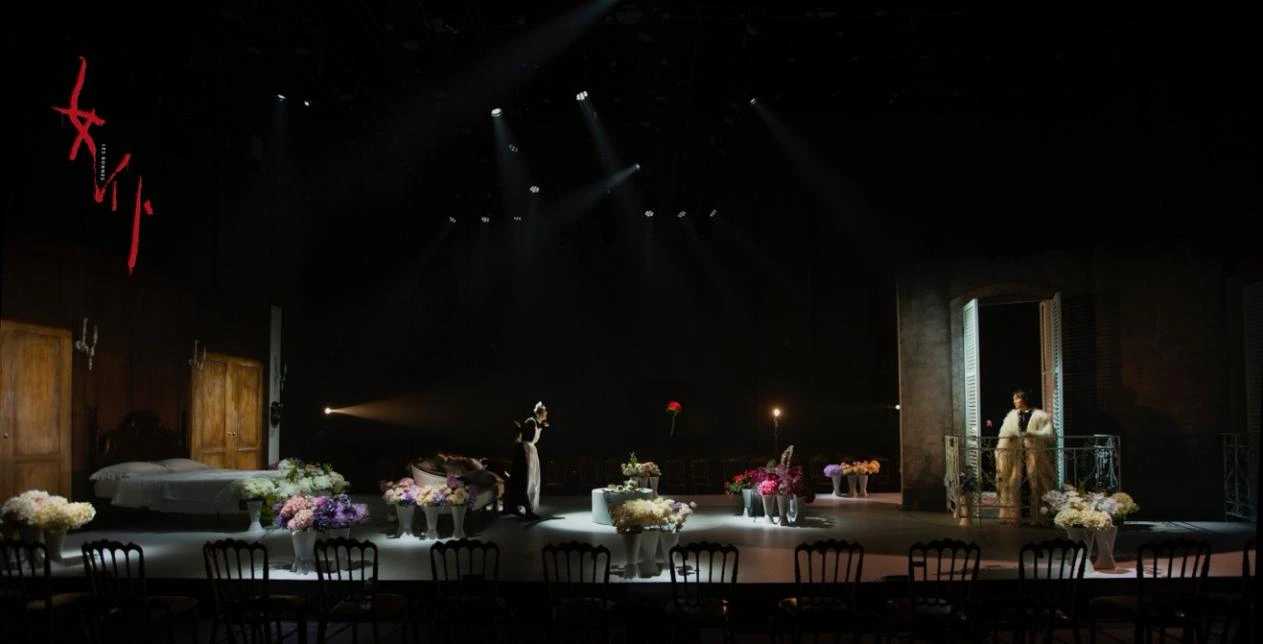
Sifan Shao: There was one element that had been part of my imagination of the play from the very beginning: flowers.
Throughout the entire process of designing the set, that element never changed. It was extremely important to me.
Question: If you had to describe the style of Les Bonnes in three words, what would they be?
Sifan Shao and Ma Xin: Nightmare. Set. Distortion… Yes, distortion.
Sifan Shao: I’m very fond of the British painter Francis Bacon.
His paintings are full of distortion: bodies, time, the entire environment. Everything seems transformed.
That sense of overall distortion was already in my mind when I began preparing Les Bonnes.
I also love the feeling of being on a film set. You have the impression that a real environment has been reconstructed, but behind it, everything might be fake.
Something can look real, while at the same time being immediately recognisable as artificial.
Question: Where do you feel the set design and the actors’ performances come together most strongly?
Ma Xin: For me, it’s the idea of a growing stage.
I’ve always wanted the productions I work on to have a life of their own.
My favourite moment is when the actors destroy the set as part of the performance. They throw flowers everywhere, overturn the scenery, and everything has to begin again.
At that moment, the stage comes alive.
It moves from birth to growth, and then to disappearance. For me, that is the moment when the set design acquires its ultimate meaning.
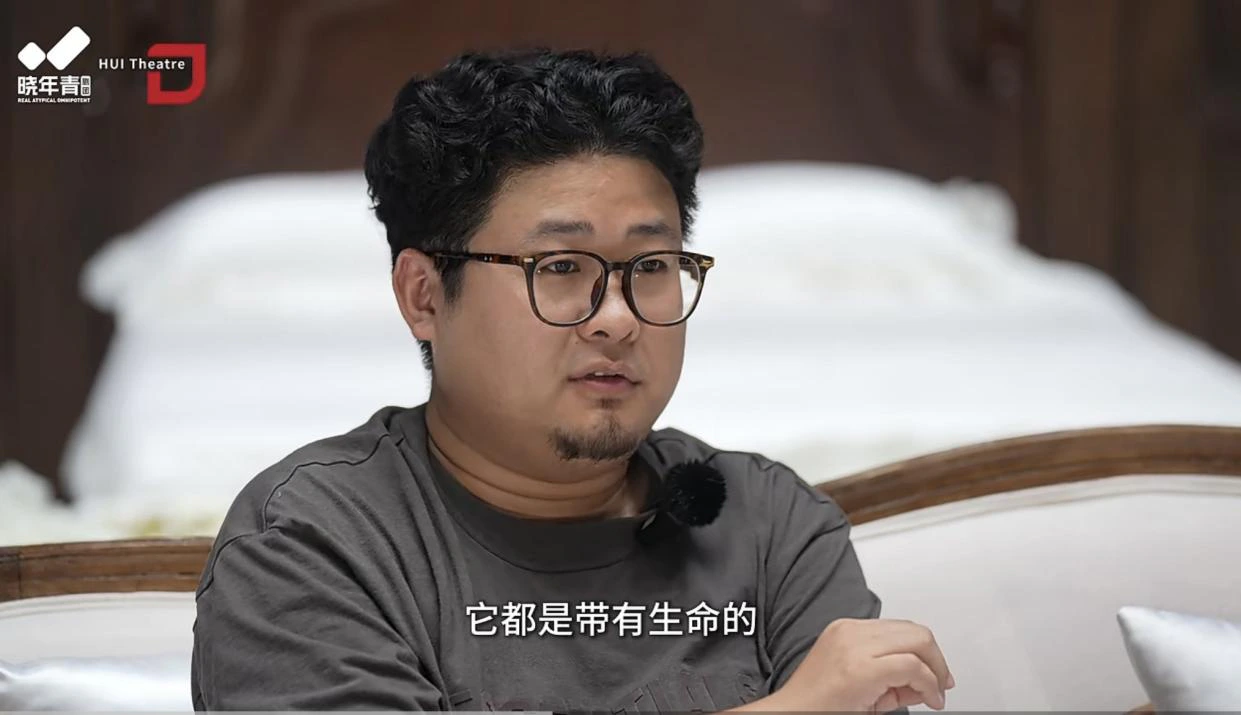
Sifan Shao: I love every corner of this set.
Take the bed, for example. As Ma Xin mentioned, it plays a part in several important scenes.
At first, it can be a playground for the maids, a playful space where they lie together.
Then, at another moment, it becomes a place of memory, evoking a past that is gone and can never be recovered.
Eventually, the bed comes to represent something entirely different, almost like the earth itself, holding them in place.
For me, this bed evokes a wide range of feelings. It’s a very powerful scenic element.
Question: What do you hope the audience will take away from this set design?
Sifan Shao: I hope that once the audience begins to notice these elements, each person will make their own connections, develop their own imagination, and ultimately create their own version of the performance.
It’s a little like a treasure chest, or a box filled with objects. Everyone discovers something different inside.
For me, that’s what immersion means.
We want to bring the audience into an environment that feels very different, so that they can experience the story.
Ma Xin: Sifan has just spoken about immersion.
In fact, there are two forms of immersion.
One relies on powerful sound, lighting and video technologies: projections, giant screens, an immersive experience of the kind created by teamLab.
The other, which is the approach we chose, works through the audience’s journey.
From the entrance to the stage space itself, through the control of lighting and atmosphere, we create a form of emotional immersion.
Reality and illusion are fundamentally a question of duality.
In our set design, both actors and spectators, once they enter the space, experience something like this:
I can see another person without being able to make them out clearly. Sometimes I cannot see them, but I know they can see me.
Meanwhile, the audience on both sides of the stage is watching the same action unfold simultaneously.
There’s something almost magical about that sensation.
Question: What kind of work would you like to create in the future?
Sifan Shao: Vitality. More irreverence, more audacity.
But always accompanied by a close and attentive observation of human beings.
That’s the kind of theatre I love.