
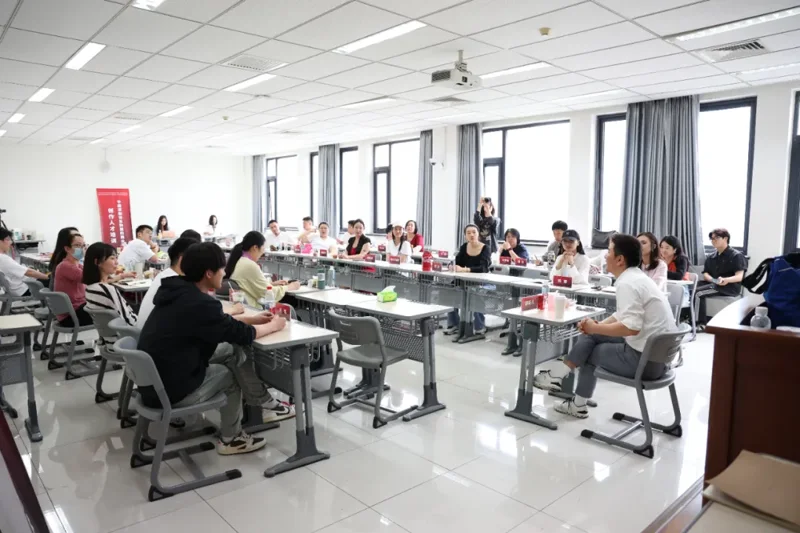
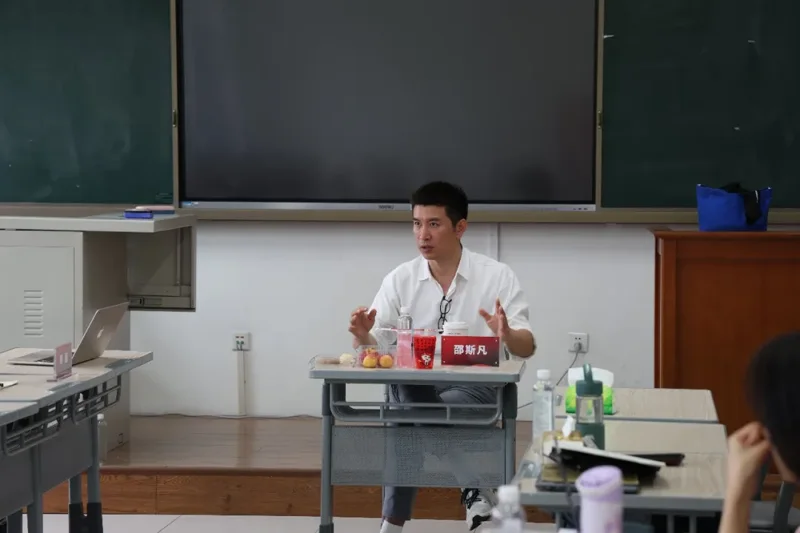
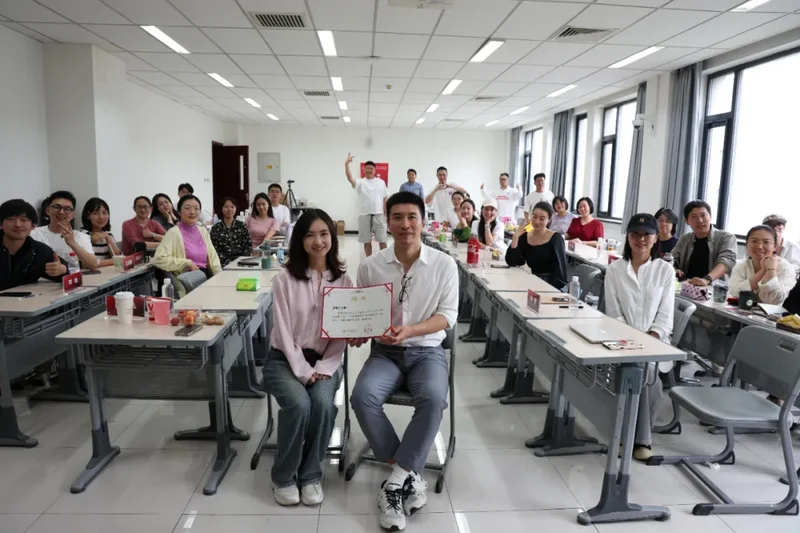
On 31 May 2025, participants in a National Arts Fund training programme on the development of Chinese theatre practice attended a performance of The Maids at Hui Theatre in Beijing. The production, presented by Xiaonianqing Theatre Company, was directed by Sifan Shao. The following day, Shao joined the participants at the Central Academy of Drama’s Changping campus for a discussion about the work.
Taking The Maids as its starting point, the discussion explored the possibilities of theatre through dreams and ritual. Questions about casting a male actor as Madame and the production’s spatial arrangement led to a wider conversation about how actors approach their characters, the relationship between theatre and everyday life, and the experiences that inform a director’s creative practice.
Beyond Gender: Finding the Character
One of the questions raised during the discussion concerned the decision to cast a male actor in the role of Madame.
For Shao, the point was never to draw attention to the gender reversal itself. From the beginning of rehearsals, he encouraged the actor not to imitate a woman’s voice or mannerisms, but to find a way into the character on the character’s own terms.
“The actor’s focus was not on playing a woman, but on playing the character.”
This distinction mattered to Shao. A theatrical device, he suggested, has to emerge from a genuine need within the work. If a choice is made simply for its own effect, the artist may struggle to believe in it.
The discussion opened onto a question that extends well beyond casting: does a particular form serve the work, or is the work being made to accommodate an effect the director has already decided to pursue?
Theatre as a Dream: Space and the Audience’s Imagination
The participants were also interested in the production’s spatial arrangement and its sense of ritual.
Hui Theatre has no permanently fixed seating configuration, allowing the performance space to be reimagined for different productions. For The Maids, the creative team chose a two-sided audience arrangement. Within a recognisable domestic setting, this configuration helped create a world that seemed to move between the tangible and the imagined.
“I think of theatre as a series of different dreams,” Shao said.
What interests him is something of the sensation that lingers immediately after waking: an experience that may be fleeting, yet remains strangely vivid.
The set emerged through a collaboration with a spatial designer from Tsinghua University’s Academy of Arts & Design. The designer initially approached the project through the language of installation art. But a theatre set must also accommodate the actors’ movements and the unfolding of the performance. Through successive exchanges and revisions, the team worked towards a space that could function both as an artistic environment and as a place for dramatic action.
Shao was reluctant to assign a single meaning to elements such as the grass and flowers that appeared onstage. He was more interested in hearing what audiences made of them.
For him, part of the artist’s work is to open up possibilities for other people’s imaginations.
The stage, in this sense, does not come with all its meanings already settled. The audience brings its own associations, memories and interpretations to what it sees.
Acting and Authenticity: When Are We Performing?
Another area of particular interest to the participants was Shao’s work with actors.
The conversation turned from what audiences see onstage to what happens in rehearsal, and to the experiences actors draw upon in approaching a role.
Shao reflected on how our understanding of a play changes over time. A text is not exhausted by a first reading. As we grow older and accumulate experience, we may find ourselves responding to the same work in entirely different ways.
He raised a question that reaches beyond the stage:
“When are we performing, and when are we truly ourselves?”
Shao described moments in everyday life when he seems to step outside his own experience and observe himself, and the people around him, from a distance.
That sensation has informed the way he thinks about acting.
In rehearsals for The Maids, he wanted the actors to look beyond the immediate circumstances of a scene and consider the world in which Genet wrote the play, as well as the conditions shaping his characters’ lives.
How might actors working today find their way towards people whose experiences are so different from their own?
Shao also recalled experimenting with live video during the creative process. Extreme close-ups were used to magnify details of the actors’ faces—their tears, their sweat—and project them for the audience to see.
Yet the process led him towards a different understanding of emotional intensity. What moves us is not necessarily the sight of tears falling. Sometimes it is the effort to hold them back, the visible struggle to keep an emotion from breaking through, that carries greater force.
Beyond the Rehearsal Room: Where Does Work Begin?
The discussion was not confined to The Maids.
Shao also spoke about the experiences, encounters and other art forms that continue to shape his practice.
He recalled a teacher from his student days who urged the class to stop spending all their time competing for rehearsal rooms.
Instead, they were told to go out: browse bookshops, spend time in libraries, see plays, visit galleries and museums, fall in love—and, above all, engage with life beyond the school.
The advice stayed with him.
For Shao, theatre-making does not begin and end in a rehearsal room. Reading, looking, meeting people and living through experiences that have no immediate connection to a production can all become part of the work, sometimes years later.
He recalled, for instance, an installation that had left a lasting impression on him. In an otherwise completely dark room, a single light bulb pulsed at a rhythm reminiscent of a heartbeat.
That encounter eventually found echoes in several of his stage productions.
Creative material, in other words, is not confined to plays or theatres. It can come from something seen in passing, an unexpected encounter, or an experience whose significance only becomes clear much later.
The Absurd and the Need to Make Choices
The conversation also touched on the absurd in The Maids, and on how a director might approach it in rehearsal.
Rather than begin with a theoretical framework, Shao prefers to return to the text itself, paying attention to what it evokes for him at a particular moment in his life.
Genet’s characters inhabit specific situations. At any given moment, they may know what they want and have their own reasons for acting. Yet seen against the larger world in which they live, their actions can appear bewildering, even meaningless.
For Shao, this tension between the urgency of a character’s immediate actions and a wider sense of meaninglessness offers one way into the play.
“The Maids can only ask questions. It cannot provide answers.”
The discussion ranged from the decision to cast a male actor as Madame to the organisation of the stage; from the actor’s relationship with a character to the ways theatre engages with the world beyond it. Again and again, it returned to the practical questions that arise in making a performance.
Genet’s characters may find themselves confronting a world in which meaning is elusive. But in any given moment, they still have desires, needs and reasons to act.
Something similar happens in rehearsal. A play may continue to raise questions that resist any definitive interpretation. Yet directors and actors must still make choices, test them in practice and discover what works through the actions they take.
Source and Credits
This article has been edited and adapted from a report published on 17 June 2025 by the Institute of Theatre Arts, Central Academy of Drama, documenting a discussion with Sifan Shao following a performance of The Maids.
Original report: 《中国演剧体系构建的舞台艺术创作人才培训》观摩研讨|邵斯凡与《女仆》:在梦境与仪式中探索戏剧的无限可能
Text: Zhang Han, Dong Futong
Photography: Wang Jinyu, Qi Yajie
Original editors: Zhang Han, Li Meng, Liu Zijun
Published by: Institute of Theatre Arts, Central Academy of Drama
Original article:https://mp.weixin.qq.com/s/qeenyfuUtBcguoucoWv5CQ